Performance of Nifty stocks – Views of a Rookie Investor

Nifty is making fresh new highs every day. Market participants are very much excited and most of the participants feel that it will touch even 7000 in the weeks to come even though macroeconomic indicators such as interest rates, Factory production, GDP growth, inflation are not so good.

Even though Nifty is at record highs, many stocks that constitute the index are still trading far below from their all-time high. So I just wanted to check the returns given by the stocks.

For that I took the closing price of all Nifty stocks on 28-Aug-2013 (on that day Nifty hit a 52 week low of 5118.85) and closing price for the same on 23-Apr-2014 (On that day Nifty hit a fresh high of 6861.60). I haven’t taken Tech Mahindra Ltd, United Spirits Limited, Jaiprakash Associates Ltd and Ranbaxy Laboratories Ltd as with effect from March 28, 2014, Jaiprakash Associates Ltd and Ranbaxy Laboratories Ltd have been replaced by Tech Mahindra Ltd and United Spirits Limited respectively. Kindly note the fact that the following stocks may hit a much higher price in this period compared to the closing price of 23-Apr-2014, but since Nifty hit a fresh high on 23-Apr-2014, I have taken that particular date as a reference for the calculation.

After that I took the annualized returns of all these stocks for a period of 246 days from the start date to the end date, end date included using the formula

(End value - Beginning value)/Beginning value) x 100 x (1/ holding period of investment in years)

(Value on 23-Apr-2014 - value on 28-Aug-2013)/ Value on 28-Aug-2013) x 100 x (1/ (246/365))

(246/365) is used in the formula for getting the holding period in years.
All annualized returns are represented as “% p.a.”
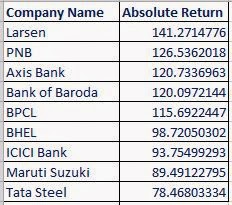
The below are the details for the same.


Best Performers


Worst Performers

The following conclusions can be derived from the above.

FMCG stock HUL did not give superior returns over this period. Even though ITC has given a return of 27 percent, these stocks under performed many other stocks of the index. The reason could be their high valuation and also they had a fantastic return over the past couple of years.

Software stocks also did not give much return in this period (Except HCL Tech). Even though Infosys touched a 52 week high of 3849.95, the stock had witnessed a sharp correction from there on. Even though the IT spending in the US and European regions are increasing, the sharp appreciation of rupee against the dollar, much more competition from the small players and obviously the high valuation were the primary reasons for the under performance.

Banking and Finance stocks gave decent returns over this period. Private sector banks such as Axis bank and ICICI bank outperformed public peers despite of their higher valuations. Interesting point to be noted is that public sector banks Bank of Baroda and Punjab National Bank gave returns of over 120 percent despite of their much higher NPA and stressed assets. The main reason for this stellar performance can be attributed to their low valuations, which means that value investors are accumulating undervalued stocks. State Bank of India was the worst performer in the public sector banking space and Kotak Mahindra from the private sector space in this period (Among Bank Nifty stocks).  Further upside in ICICI bank and Axis bank will be capped as FII limit in these stocks has reached the maximum limit. SBI has much more potential upside considering this. But their nonperforming assets are an area of concern.

We can see that pharmaceutical stocks are also struggling to make returns over this period considering their much higher valuation. But we should not forget the fact that these stocks gave decent returns in the past when other stocks are struggling to give even some positive returns.

The trend from FMCG, pharmaceutical and IT is clear that investors are taking their positions from these defensive bets to other cyclical stocks over this period.

In the 48 stocks that I considered from Nifty, only one stock gave negative returns over this period. It is NTPC. The reason for this is issue regarding to power price regulation and all. But since NTPC is the largest power producer in the country and has a good past performance as well as a good balance sheet, it should give better returns in the long run.

Power generation companies Tata Power and Power grid Corporation managed to get 18 percent returns over this period which is very low compared to other stocks.

Real Estate major DLF managed to get 22.93 percent returns during this period. But these returns can be attributed to rising tide sentiment as a rising tide lifts almost all the boats. The company has a lot of debts in its books and the overall real estate market has taken a hit because of the higher interest rates scenario. Probably that could be the reason investors are staying away from this stock.

Metal stocks which are infamous for their cyclical behavior gave some average returns during this period but not much. Even though Tata steel gave a return of 78.46 percent, the stock is still trading way below its all-time high. I think the lower valuation as well as improving global sentiment should take these stocks into much higher position.

Always remember even if the bear market is catastrophic enough to take stocks into historical low levels, there will be a much strong bull market to take back these stocks into new fresh highs because market is a pendulum that swings between unjustifiable pessimism and unbelievable optimism.


The views are personal. J

How much insurance cover you need


Life insurance is a contract between an insured and an insurer, where the insurer promises to pay a designated beneficiary a sum of money in exchange for a premium, upon the death of the insured person. Basically insurance is a particular type of risk management.

So the question comes to everyone’s mind is that how much insurance cover a person require, in order to compensate the financial loss the family suffers in case of his death.

Let’s take an example to explain this.

Raju is 30 years old working in a multinational company. His wife is a home maker. They have 2 sons aged 1 and 3. His salary details, assets and liabilities are listed below.

All figures are in INR

Gross monthly income after deducting PF, income tax etc.
50000
EMI towards car loan
5000
EMI towards home loan
10000
Net income available to family
35000

After deducting the EMIs for car and home, the net income which is available to Raju is 35000 per month at this particular point of time.

This income (INR 35000) will be utilized for day to day activities, food, clothing, entertainment, emergencies, and the balance amount after all these will be saved.

In case of the unfortunate demise of Raju, the inflow of cash that Raju generates for his family (35000 per month at this particular point of time) will be stopped.

So the insurance cover that protects Raju should be roughly equivalent to the sum of all his future cash flows that he may generate, if he lives till his retirement.

In order to calculate this we have to consider the following parameters.
                    1)      Retirement age
                    2)      Approximate hike in his net income on an yearly basis

We are assuming that he is planning to retire at the age of 55. He expects that his increase in net income will be 6% annually.

The following table gives his expected annual net income for a period of 25 years (currently he is 30 and his retirement age is 55).


In the first year his net income per month is 35000. So annual income for the first year will be (35000*12) = 420000.

Since he expects a 6% hike in his net income, annual net income for the second year will be
(Annual net income for the 1st year) + ((annual net income for the 1st year)*6/100)
420000 + (420000*6/100) = 445200

Similarly for the third year, annual net income will be
(Annual net income for the 2nd year) + ((annual net income for the 2nd year)*6/100)
445200 + (445200*6/100) = 471912 and so on.

Since the EMI towards car loan is for 4 years, from the fifth year onwards a sum of (5000*12) = 60000 can be added to his net income.

Also since the EMI towards home loan is for 20 years, from the 21st year onwards a total of (10000*12) = 120000 + 60000 (towards EMI of car) = 180000 can be added to his net income.

So the updated net annual income after adding these amounts will be


Sum of net annual income earned by Raju in the next 25 years, assuming an increase of 6% annually will be 24903095.02 

Since these cash flows occur at uneven interval of time, we have to calculate the net present values of all these future cash inflows Raju may produce, if he is expected to live at least till his retirement.

In order to find the present values, we have to consider three important parameters.

                       1)      Retirement age
                       2)      Expected rate of return
                       3)      Inflation

Impact of inflation

In economics, inflation is a sustained increase in the general price level of goods and services in an economy over a period of time. So over time, the value of one unit of money will go down because of the inflation effect and the same amount of money will not be able to purchase as much with that unit of money as he could have purchased earlier. In other terms, inflation eats away purchasing power over time.

So if we didn't consider inflation factor while calculating the present value, it may produce erroneous results and will have a negative impact on how much insurance cover he requires.

We are assuming that inflation for a period of 25 years will be averaged at 6 percent per annum and the rate of return for this period will be averaged at 15 percent per annum (assuming that the average equity oriented mutual fund may generate this return over this period).

So the inflation adjusted return for calculating net present value will be

((((1 + expected rate of return) / (1 + inflation rate))-1)*100)

((1+15/100) / (1+6/100) – 1)*100 = 8.4905%

To calculate the net present value, we can use MS Excel.

Steps for calculating net present value in MS Excel is given below
              
                    1)       Open MS Excel and enter all the cash flows (this case his annual income over a period of 25 years) 


Click on a blank cell and enter the following
=NPV (8.4905%, B1:B25)

The first argument is the inflation adjusted return. (Always remember to add % sign at the end of the first argument)


Second argument is the values for which we have to calculate the net present values. Since here the values are spread across cell number B1 to B25, we will mark it as B1:B25


After entering the command, press Enter and the value we get is the net present value.

In this case the net present value after executing the command is 7,938,108.08


In other words, this is the present value of all future cash flows Raju may generate if he lives till his retirement or this is the financial loss of the family if Raju die today.


Next we have to consider his assets and liabilities.


His assets (current assets as well as fixed assets except the car he owns and the house he lives in) and investments includes


Fixed deposits PF and debentures worth 10 lakhs

Gold worth 5 lakhs
Shares and mutual funds worth 3 lakhs
Plot worth 20 lakhs
Insurance cover of 10 lakhs
Total assets = 48 lakhs

His liabilities are


Car loan (EMI of 5000 for 4 years) – (5000*48) = 240000

Home loan (EMI of 10000 for 20 years) – (10000*240) = 2400000
Total liabilities = 26.4 lakhs

So the adequate insurance cover he has to take is


(Net present value of his future cash flows + liabilities – current assets and investments)


7,938,108.08 + 2640000 – 4800000 = 5778108.08


Approximately 57.7 lakhs (on the assumption that he may die at this point of time)


The below mentioned calculation is based on my assumptions and conclusions. Investors are advised to consult financial consultants before taking insurance policies/making financial decisions.


Views are personal :)


SPECTACULAR JANUARY SERIES

Sensex closed at 15358 on December 30, 2011. A person who purchased some stocks at this rate will get excited about how much money he has made on stocks in just one month. :-)
Sensex in January. Courtesy moneycontrol.com 

On 31st January Sensex closed at 17193. About 1835 points up in just one month. Approximately 13 percent rally so far.

BSE 500 index witnessed a gain of 13.2 percent. Top gainers from this include 
                        IVRCL - 79% gain
                        Hindustan copper - 67% gain
                        Lanco Infratech - 60% gain
                        Reliance Infra - 57% gain

In Sensex  however, the top gainers were from the Tata club. Tat motors closed January with a return of 37 percent. Tata Steel ended with 35 percent gain.

But about 50 percent of the 1700 point gain of the Sensex was contributed by ICICI Bank, L&T, RIL and HDFC.

I regret that I did not bought any of these shares in December when they were trading at discount rates. :-( But I purchased Yes Bank Ltd and that gave me about 30 percent return in just one month. :-)

The slowing inflation rates, better than expected Q3 results, Hints given by RBI for a rate cut, 50bps CRR cut to manage liquidity constraints, Above average IIP numbers etc. made huge fund inflow from FIIs into the Indian Stock market.

According to BSE, the net fund inflow from FIIs into the Indian market totalled Rs.8, 816 crore till January 30.

DIIs were net sellers pulling out an amount of Rs.6, 495 crore. Retail investors too have been net sellers.

There is a chance for a Bullish rally, which will be triggered most probably in the first half of the calender year.

Regards Hari " लोका समस्ता सुखिनो भवन्तु "