When TCS is the cash cow of Tata Sons


Tata consultancy services again came into the lime light last week by announcing a strong first quarter results and becoming the first Indian company to achieve the 5 lakh crore mark in terms of market capitalization. The competitors to TCS such as ONGC, Reliance, ITC etc. (in terms of market cap) are far below the level achieved by TCS. 

So I just wanted to check how much TCS is worth to Tata Sons compared to other Tata group companies.

For that I took 12 major Tata group companies and collected their market cap (for July 24, 2014), Net sales and net profit. (On a consolidated basis as on FY14)

The following interesting facts have been observed.


The combined market cap of 12 Tata group companies are 814,681.81 lakh crore (as on July 24). The biggest contributor is obviously TCS with a whopping 62.2 percent share in total market cap. The next biggest gainer is Tata motors. But its contribution is 19.11 percent almost one third of TCS.

The next thing I considered is the net sales and net profit (in a consolidated basis as on FY 14).


The revenues of 12 major Tata group companies for FY2013-14 was at 562,496.87 crore in which TCS contributed to just 14.83 percent. Tata motors were the biggest contributor with a 41.86 percent share followed by Tata Steel with 26.6 percent. But when we come to net profit scenario, TCS contribution was 51.16 percent of the total net profit (total reported net profit by these companies were 37,787.83 crore as on FY14) reported by these companies. Tata motors secured the second position with 37.32 percent share (But most of its profit and revenue came from JLR) and Tata steel came third with a meager 9.7 percent. Interesting isn’t it? The important factor to consider in this scenario is even though TCS contributed a meager 15 percent to the Tata Group companies’ (that I have considered) revenues; TCS contributed a whopping 51.16 percent share in net profit.

From these figures it is pretty much clear that it is this single IT service company that have enabled Tata Sons to keep investing in group companies. Tata group companies especially Tata steel and Tata motors have huge debt in their books mostly because of the acquisition of JLR by Tata motors and Corus by Tata steel in 2007. The situation got worsened because of the global recession in 2008. Even though the JLR contribute significant amount of bottom line to Tata motors, the performance of Corus is quite disappointing. Even though Tata steel posted a net profit of 3663.90 crore in FY14, it reported a net loss of 7,362.39 crore in the FY13 (in a consolidated basis). Apart from this the recent announcement of Japan’s Docomo to quit the partnership with Tata Tele services which they had in the telecom space and the recent decisions to enter into the aviation sector with Air Asia and Singapore Airlines also need a lot of money. Recently announced dividend payout of Rs. 12750 crore by TCS, the highest ever dividend payout by an Indian company should be seen in this regard. Tata sons will get around 9300 crore from this dividend payout since they have around 74 percent stake in TCS which they can utilize for investment in group companies. 

So TCS is and continues to be the lender of the last resort for Tata group.

Views are personal :)

Data collected from moneycontrol.com, firstpost.com and the respective company websites.

ALL THAT GLITTERS IS NOT GOLD

India’s current account deficit (CAD) for the January-March period narrowed sharply to $1.2 billion (0.2 per cent of GDP) from $18.1 billion (3.6 per cent of GDP) in the same period last year, which was also lower than $4.2 billion (0.9 per cent of GDP) in the October-December quarter of 2013-14.

When we observe the figures of current account deficit, we could easily figure out reduction in current account deficit is mainly attributed to the reduction in gold imports, which amounted to $ 5.30 billion, lower than $15.80 billion in the fourth quarter of 2012-13. Thanks to the measures taken by the UPA government to control the import of gold by increasing the excise duty from 2 to 6 and eventually to 10.

So the question comes to everyone's mind is that is this measure to control the current account deficit by controlling the supply of gold is sustainable? The answer is obviously no. It is pretty much clear that although government has taken stringent measures to control the import of gold, the fantasy of Indian households towards gold as a safe haven to beat inflation has never receded. So the only thing we can do to curb the obsession of gold is not to cut the supply but to curb the underlying demand. How can we achieve that?


In order to find the ways to control the obsession of gold, first we have to consider why people are considering gold as a superior investment vehicle.

Traditionally Indian middle class investors tried and tested the following asset classes

Bank deposits
Equity and equity oriented products
Gold

Most of the people got their fingers burned by investing in equities.

The first reason was that most of the first time investors usually start equity investment at the tip of a bull market. The reason can be attributed to different media that gives much more hype to the stock related news. News like ‘Nifty touched all-time highs, investors wealth multiplied by several times’ obsess first time investors and they take their exposure in equities for the first time on the assumption that equities can deliver superior returns in a short period of time. This euphoria can be seen everywhere. But the investments that they make will be in overvalued stocks because bull markets will stretch the valuations of stocks to unprecedented levels and since they make most of their investments at the peak of a bull market, eventually they will end up in loss as graham said all the bull markets will eventually end in an unjustifiable bear market.

Second reason is that attitude of most of the people is that they need quick profit. While investing in equities they are not considering the fact that investment in equities means investment in companies and the profit won't come in a day or two.

Third reason is even though people have long term financial goals, they are unwilling to take short term losses which are apparent in equities.

Because of all these factors, people consider equity investments as an investment vehicle to lose money. As a result traditional savings methods like gold and bank deposits got much more exposure than it ought to be.

In the last decade especially in the past 4 years, our country has been experiencing stubbornly high inflation. Consumer price index based inflation is somewhere around 8 to 10 percent for the past couple of years. People realized that bank deposits that gave a mere return of around 7 to 9 percent will not be enough to beat the inflation. So the exposure towards gold increased further based on the assumption that gold can give superior returns which is capable of beating the inflation.

So coming to the central topic of this article, how can we curb the demand of gold or more precisely how can we reduce the exposure towards gold in one's portfolio thereby making our balance of payments much more stable? There could be many ways but in my view the most effective way is to encourage people to invest in financial products such as equity and equity oriented products, debt instruments etc. rather than in physical products, teach them about various financial products available, make them aware of the benefits of investing as well as the risk factors involved. Encourage them to save for long term. Also make them aware that investment in equities can generate substantial capital appreciation in the long run. As nation progress everyone should get exposure towards formal financial system. This exposure towards the formal financial system will eventually help people to understand the various asset classes and the benefits of investing in various assets and also the risk involved. So in the long run exposure towards physical assets will reduce marginally and the people will allocate more exposure towards equity. Thus the financial markets of our nation will flourish and it will definitely going help to help our economy in a positive way. I know this is not an easy task and it requires Herculean efforts from concerned departments. But we have to take short term pains for a stronger and incredible nation.

I firmly believe in the long run no asset class can give the returns which equities can give. Take the past 20 or 30 years of data and you will come to know. But past returns does not necessarily mean that it will continue in the future. But as an investor we should and have to believe in a better tomorrow :)

It does not mean that I loathe gold. What I believe is the exposure of gold in our portfolio should not exceed 10 percent of the total portfolio value.


So to conclude curbing demand of gold by cutting down supply is not an option in the long run, even though it may work in the short run. The effective way is to curb the demand itself by making citizens aware of the various financial products apart from gold.

Views are personal :)

Performance of Nifty stocks – Views of a Rookie Investor

Nifty is making fresh new highs every day. Market participants are very much excited and most of the participants feel that it will touch even 7000 in the weeks to come even though macroeconomic indicators such as interest rates, Factory production, GDP growth, inflation are not so good.

Even though Nifty is at record highs, many stocks that constitute the index are still trading far below from their all-time high. So I just wanted to check the returns given by the stocks.

For that I took the closing price of all Nifty stocks on 28-Aug-2013 (on that day Nifty hit a 52 week low of 5118.85) and closing price for the same on 23-Apr-2014 (On that day Nifty hit a fresh high of 6861.60). I haven’t taken Tech Mahindra Ltd, United Spirits Limited, Jaiprakash Associates Ltd and Ranbaxy Laboratories Ltd as with effect from March 28, 2014, Jaiprakash Associates Ltd and Ranbaxy Laboratories Ltd have been replaced by Tech Mahindra Ltd and United Spirits Limited respectively. Kindly note the fact that the following stocks may hit a much higher price in this period compared to the closing price of 23-Apr-2014, but since Nifty hit a fresh high on 23-Apr-2014, I have taken that particular date as a reference for the calculation.

After that I took the annualized returns of all these stocks for a period of 246 days from the start date to the end date, end date included using the formula

(End value - Beginning value)/Beginning value) x 100 x (1/ holding period of investment in years)

(Value on 23-Apr-2014 - value on 28-Aug-2013)/ Value on 28-Aug-2013) x 100 x (1/ (246/365))

(246/365) is used in the formula for getting the holding period in years.
All annualized returns are represented as “% p.a.”
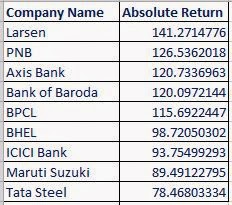
The below are the details for the same.


Best Performers


Worst Performers

The following conclusions can be derived from the above.

FMCG stock HUL did not give superior returns over this period. Even though ITC has given a return of 27 percent, these stocks under performed many other stocks of the index. The reason could be their high valuation and also they had a fantastic return over the past couple of years.

Software stocks also did not give much return in this period (Except HCL Tech). Even though Infosys touched a 52 week high of 3849.95, the stock had witnessed a sharp correction from there on. Even though the IT spending in the US and European regions are increasing, the sharp appreciation of rupee against the dollar, much more competition from the small players and obviously the high valuation were the primary reasons for the under performance.

Banking and Finance stocks gave decent returns over this period. Private sector banks such as Axis bank and ICICI bank outperformed public peers despite of their higher valuations. Interesting point to be noted is that public sector banks Bank of Baroda and Punjab National Bank gave returns of over 120 percent despite of their much higher NPA and stressed assets. The main reason for this stellar performance can be attributed to their low valuations, which means that value investors are accumulating undervalued stocks. State Bank of India was the worst performer in the public sector banking space and Kotak Mahindra from the private sector space in this period (Among Bank Nifty stocks).  Further upside in ICICI bank and Axis bank will be capped as FII limit in these stocks has reached the maximum limit. SBI has much more potential upside considering this. But their nonperforming assets are an area of concern.

We can see that pharmaceutical stocks are also struggling to make returns over this period considering their much higher valuation. But we should not forget the fact that these stocks gave decent returns in the past when other stocks are struggling to give even some positive returns.

The trend from FMCG, pharmaceutical and IT is clear that investors are taking their positions from these defensive bets to other cyclical stocks over this period.

In the 48 stocks that I considered from Nifty, only one stock gave negative returns over this period. It is NTPC. The reason for this is issue regarding to power price regulation and all. But since NTPC is the largest power producer in the country and has a good past performance as well as a good balance sheet, it should give better returns in the long run.

Power generation companies Tata Power and Power grid Corporation managed to get 18 percent returns over this period which is very low compared to other stocks.

Real Estate major DLF managed to get 22.93 percent returns during this period. But these returns can be attributed to rising tide sentiment as a rising tide lifts almost all the boats. The company has a lot of debts in its books and the overall real estate market has taken a hit because of the higher interest rates scenario. Probably that could be the reason investors are staying away from this stock.

Metal stocks which are infamous for their cyclical behavior gave some average returns during this period but not much. Even though Tata steel gave a return of 78.46 percent, the stock is still trading way below its all-time high. I think the lower valuation as well as improving global sentiment should take these stocks into much higher position.

Always remember even if the bear market is catastrophic enough to take stocks into historical low levels, there will be a much strong bull market to take back these stocks into new fresh highs because market is a pendulum that swings between unjustifiable pessimism and unbelievable optimism.


The views are personal. J